
Your guide to organising local events
Context
The UK Government recently published its Animal Welfare Strategy for England, outlining commitments that could significantly affect the lives of farmed animals. The Government has begun launching public consultations as a follow-up to specific issues raised in the Strategy, and what happens next could shape the future for millions of animals trapped on farms across the UK.
What is a public consultation?
A public consultation is a process in which the Government invites the public, experts, and organisations to share their views on specific proposals before final decisions are made. Consultations help inform and shape final policy, creating an official record of evidence and public support for change. They give people a direct opportunity to influence government decisions and speak up for farmed animals.
Why are consultations important?
Government officials are meant to represent the public, and consultations allow us to use our voices to directly impact the lives of farmed animals, who are too often overlooked, neglected, and hidden from public view. Consultations are one of the most effective ways to amplify the experiences of farmed animals and demand better for those trapped in cruel systems.
Consultations play a critical role in mapping out how the Government delivers on its commitments and can help turn promises into meaningful, real-world outcomes.
Spending just 10-20 minutes responding adds your voice to a growing movement of people advocating for farmed animals. Together, this collective pressure has the power to impact millions of animals currently trapped in the system. When large numbers of people submit authentic, personal responses, it sends a clear message to decision-makers that the public is paying attention, demands change, and is dedicated to seeing these commitments turned into tangible outcomes.
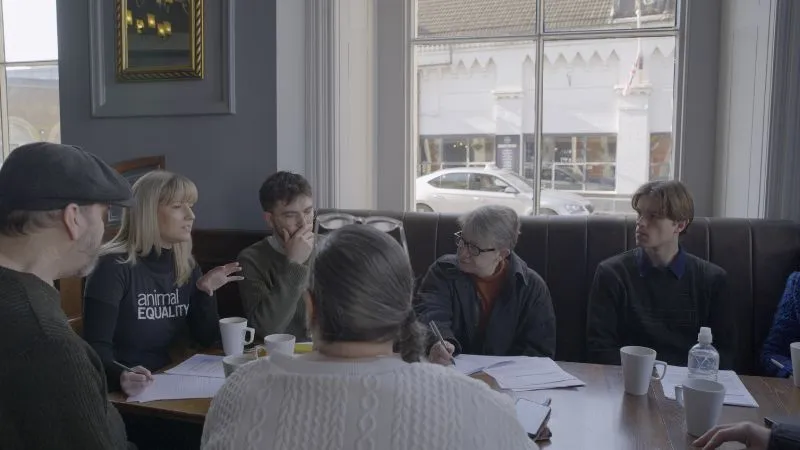
Responding to a consultation
The most important thing is to respond in your own words. Short, personal responses are often far more powerful and memorable than long, copied templates. You don’t need to be an expert by any means. All that’s required is your voice, explaining why the animals affected by the consultation deserve protection and why change is needed.
There are currently two consultations open (both closing on 9th March 2026), with more expected in the future, so keep an eye out for updates from Animal Equality:
- Cage reform: proposed ban on keeping ‘laying hens, pullets, and breeder layers’ in cages (hens exploited for their eggs)
- Lamb welfare: proposed changes to castration and tail docking methods
Please email us at [email protected] to get a copy of our consultation response guide, designed to make this incredibly important process as straightforward and accessible as possible.
Consultation events: Communities against cages!
Local consultation events are powerful ways to help more people take part in consultations that affect farmed animals. By creating a space in your community dedicated to spreading awareness and engaging the public, you can help people understand why consultations matter and support them to submit meaningful, personal responses.
These events are about empowerment, not expertise. You have the opportunity to encourage participation, explain why the issue matters, and make it as easy as possible for people to take action. And, while we always encourage people to ditch animal products from their diet, you don’t need to be vegan to take part in a consultation and to impact millions of lives through this process – the more the merrier. Everyone is welcome!
What is a consultation event?
A consultation event is an informal, in-person setup where members of the public are invited to spend 10-20 minutes responding to an open government consultation. The aim is to engage with people where they already are and give them the time, tools, and confidence to respond.
This might simply look like an hour or two sat at a table or stall at your local café, library, bookstore, university or community centre.
Where to host your event
Some good venue options are places where people tend to sit and stay for a while, which could include your local:
- Public library
- Community centres
- University campuses
- Vegan cafés or restaurants
- Independent bookstores
- Pubs or social spaces
Contact venues in advance to explain that you would like to hold a short civic engagement activity to help people take part in a government consultation (not involving any selling or fundraising). From there, you can coordinate and secure permission from the venue.
What would be useful to have
- A small table and a couple of chairs, which may already be provided by the venue
- A clear poster explaining what the consultation is, why it matters for animals and a QR code linking directly to the consultation page
- Printed copies of Animal Equality’s consultation response guidance
Animal Equality can provide printable PDFs (posters, QR cards, response guidance) or can have printed materials sent directly to you, if needed.
Suggestions for setting up your space
- Set up posters so they are easily visible to passersby
- Sit beside the table rather than behind it to seem more approachable
- Then just be yourself! Remaining open, friendly, and approachable will likely lead to the most public engagement and conversation
- Please feel free to take photos of your set-up and any other visuals you’d like to capture – we’d love to see! Just make sure you get permission from those that attend and don’t include pics of children
Supporting people to respond
- Encourage people to respond in their own words
- Reassure them that even short responses are impactful
- Offer the consultation guidance as support
- If someone wants to complete the consultation later, you can encourage them to scan the QR code or photo of the poster and gently remind them of the consultation closing date
After the event
First, give yourself a huge pat on the back! Your efforts help turn public concern into real political pressure and can make a genuine difference to the lives of millions of animals 👏
We would love to hear from you about how it went! Thank you again for being part of the people leading the way towards a kinder world for animals.
save animals, eat plant based
As a consumer, you hold the power to protect animals from the meat industry. Every plant-based meal saves animals from a life of misery in factory farms and slaughterhouses.